DISCLAIMER

These lessons are based on my personal studies and therefore my own opinion. The reader should not accept anything simply because I wrote it, nor should the reader accept anything anyone present to you as absolute truth. You should always check out a teacher or preacher or anyone else claiming to be an authority on their facts. Go to the Scriptures and conduct your own study.
Showing posts with label Ehud. Show all posts

Thursday, October 4, 2018

DEPRAVITY WITHOUT GOD PART 3: OPHNIEL, EHUD AND THE OX-GOAD SWINGING SHAGMAR

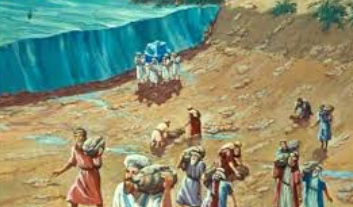
Anyway, Joshua led the Israelites across the Jordan. The critics spend a lot of time on Moses parting the red sea, claiming it was a shallow place where strong winds blew at certain times of year, which cause a gap of dry land to appear seasonally, and thus the parting of the Red Sea was no big miracle at all. For some reason they don’t seem eager to jump on Joshua and the parting of the Jordan River, though. Joshua led the whole of the Israelite nation across the Jordan on dry ground. The critics can’t say it was a shallow place. It was high tide for the river coming doing the harvest season.

Oh well, you critics can’t win them all.

But Joshua did win at Jericho (God did actually) and the walls of the city tumbled down. Of course, archeologists think Jericho may have been the oldest city in the world, so maybe it was just so old it turned to dust when those trumpets blew.

Now Joshua died after he had divided the land between the tribes. And all the older generation, which had come out of Egypt with Moses  and Joshua were passed away. A new, younger generation arose and they did evil in the sight of God. They served Baal and Ashtoreth, (pictured on right) because they had not done what God had ordered by totally wiping out those peoples of Canaan. Instead they intermarried and then they began to forsake God for the deities of these people, and these were evil.

Baal was a horrific god worshipped by those of the Levant. The countries considered part of Levant are Cyprus, Egypt, Iraq, Israel, Jordan, Lebanon, Palestine, Syria and Turkey. The name ISIL  (also known as Isis) stands for the Islamic State of Iraq and the Levant. Note that Israel was considered part of the Levant.

The gods these people, and whom Israel began adopting, were Baal and Ashtoreth sometimes called Asherah).  Baal was believed to have power over wind, rain and fertility. It times of crisis, the Baal worshipers sacrificed children to the God, especially the first born. Consider Baal the god of abortion.

Ashtoreth was a fertility goddess often depicted nude with exaggerated genitals. She was not only the mother of Baal; she was also his mistress. Hows that for a twisted family? She was worshipped through the practice of sex and this led to religious prostitution. The people commonly engaged in obscene public sexual acts with these prostitutes. 

Upon Joshua’s death God had raises up Judges, but the Israelites wouldn’t harken to the Judges, and when these initial Judges were dead, the people corrupted themselves even more. God was so angry he would no longer drive out their enemies. After a while he allowed Israel to fall into the hands of their enemies until finally the people cried out to him. 

And an angel of the Lord came up from Gilgal to Bochim, and said, I made you to go up out of Egypt, and have brought you unto the land which I sware unto your fathers; and I said, I will never break my covenant with you.

And ye shall make no league with the inhabitants of this land; ye shall throw down their altars: but ye have not obeyed my voice: why have ye done this?

Wherefore I also said, I will not drive them out from before you; but they shall be as thorns in your sides, and their gods shall be a snare unto you.

And it came to pass, when the angel of the Lord spake these words unto all the children of Israel, that the people lifted up their voice, and wept.

And they called the name of that place Bochim: and they sacrificed there unto the Lord. (Judges 2:1-5) [Bochim means "weepers"]

Not only wouldn’t God go before the Israelites and drive out the others in the land, God was so angry with them for their unfaithfulness, he gave them over to the rule of the Mesopotamian King, Chushanrishathaim, who demanded their servitude for eight years. They were getting right back to where they were in Egypt.

Now the Israelites stopped ignoring God and cried out for his help, and then God raised up a new deliverer for them out of the tribe of Judah. This man was the son of Kenaz, who was the younger brother of Caleb. 

Kenaz son’s name was Othniel and the name may mean “God is my strength.” Othniel defeated the King of Mesopotamia. He ruled Israel for 40 years and they had peace and rest. But then Othniel died and guess what happened?  (Judges 3:8-11)

Those Israelites slid right back to evil ways.

You must keep these things in mind. We think America is pretty strong militarily and we take some comfort in our might. We better consider where our faithfulness to God is instead. Remember God gave the Israelites over to Mesopotamia, then rescued them. Now God strengthened the King of Moab, named Eglon. God allowed Eglon to conquer the Israelites. We have a long history of God allowing countries to take over those who once looked to him and then slid away. The Israelites became the servants of Moab for the next 18 years, after which they cried again to God.

People may not be faithful, but God is, if the people turn back to him.  This time God raised up the son on one Gera, a Benjamite. 

This man was named Ehud. Ehud has become something of a popular name with modern Jews. In fact, two of Israel’s ministers were named Ehud: Ehud Barak and Ehud Olmert. The true meaning of the name isn’t known, but it has been conjectured that it means either Unity or Glory. Either of these worked for this Ehud that God raised up.

Ehud was left-handed and this proved beneficial to him. The people prepared a present for Eglon, King of Moab, and choose Ehud to deliver it. After all, he was God’s new deliverer.

Ehud made himself a short sword, a dagger actually, one with two very sharp edges. It was a foot and a half long. Ehud strapped this weapon on his right thigh hidden beneath his clothes. He traveled to Eglon’s place and there the present was presented. Ehud told him he had a secret errand for the king, so Eglon sent every one else out of his parlor and locked the doors.

The doors were shut and these two men were alone. Ehud approached the King and said he had a message from God. He arose and came to Eglon while at the same time reaching with his left hand and drawing the dagger strapped to his right thigh. He plunged this 18 inch dagger into Eglon’s belly up to the hilt.

Eglon was a obesely overweight man; that is, he was fat. (Warning, this gets a bit gross here.) The whole dagger had sunk into his flesh and Ehud could not pull it out. It went in so deep that the content of his bowel’s leaked out.

This also proved beneficial for Ehud escape.

When Eglon’s guards came to reenter the chamber they found the doors locked. They also smelled the foul odor and deduced that the King must be in the closet relieving himself, or as they delicately put it: “Surely he covereth his feet in his summer chamber.”. They did not want to disrupt such a private moment and embarrass their king, so they waited.  And they waited and waited until they felt foolish waiting and broke in. All they found was their king dead on the floor and Ehud gone.

Ehud escaped to his own territory and there blew a trumpet in the mountain of Ephraim rallying his troops behind him. His people followed him down the mount as he shouted, “Follow after me: for the Lord hath delivered your enemies the Moabites into your hand!” They went down and conquered Moab without the loss of a single Israelite and Ehud ruled over Israel for the next 80 years. (Judges 3:9-30)

Immediately after Ehud, God raised up Shamgar, the son of Anath. Anath is a curious name. Anath was something or someone set apart to God, so devoted to God that it could not be redeemed and so it also came to mean accursed, an anathema. There is also the Arab town of Anath, called Anathoth in Joshua 21:18, a Benjamite village named as a City of Refuge. This was also the home town of Jeremiah (Jeremiah 1:1). 

The name Anath is also that of a Canaanite diety, the goddess of love and war, a sister of Baal. Some think where it says “the son of Anath”, it is not referring to Shamgar’s parent at all, but is a title and that Shamgar was not actually a Israelite at all, but foreign, perhaps a Hittite and in the past, at least, a worshipper of Canaanite deities. 

We are not given any introductory information in the Bible about Shamgar, where he was from or anything about how long he might have ruled, if indeed he did, only that he came after Ehud and that he delivered Israel as well by slaying 600 Philistines with an ox goad. (Judges 3:31)  He is briefly mentioned again in Judges 5:6 as part o what is called the Song of Deborah.

You know, in fact, Shamgar, with his bid stick, known as an Ox Goad, may not even ruled over Israel at all. He may have just popped up on the scene when they needed a strong man to kill a lot of Philistines, because the next thing the Bible really tells us is the “Children of Israel again did evil in the sight of the Lord, when Ehud was dead.” (Judges 4:1)


Yes, they did it again. It is like when the cat is away, the mice will play, or maybe in this case we should say cats. Every time God raises up a protective cat and the cat dies, the Israeli mice turn to evil. They just don’t learn.

Thursday, September 20, 2018

DEPRAVITY WITHOUT GOD PART 1: THREE HOMBRES WE HARDLY KNEW YE

It has been a while since you last heard from me, hasn’t it. I am sure you used that time when I wasn’t pestering you to  really dig into the adventures of those three dashing musketeers: Othniel, Ehud and Shamgar. Of course they really weren’t musketeers. The musket hadn’t even been invented yet. And no, Shamgar was not their pet dog.Truthfully, these guys might not even known each other.

Afterall, Othniel (The Big O as I call him) was from Judah and dead before Ehud grabbed any headlines.
And Ehud wasn’t from Judah; he was a Benjaminite.

 Of Shamgar, we are not told much. Even though his name comes up twice, but in neither time does it say where he was from or where he went after his brief moment of note. There is speculation offered by scholars based solely on his name that he was the offspring of a mixed marriage between an Israelite and a Canaanite.

But why am I telling you all this when you probably have often pondered and discussed these guys at parties and other  get togethers. Perhaps I should be asking you about them and their deeds.

But before we consider their deeds, lets look at some Israeli history because how did we ever get to the place where these three guys got the spotlight? Before them we had some superstars that everybody knows upon the world’s stage, Joseph, Moses and Joshua.Yet we got some kind of hiccup after Joshua passed away and people were left on their own without God, and without God depravity fills the void and into that vacuum came Ophniel, Ehud and Shamgar.

It took a lot of history to reach that point, so a flash review may be in order. First you got to realize the Bible isn’t a collection of snappy little stories. It is one big book written by God and everything is a connected, logical, continuing narrative. But we are not going to go all the way back to the beginning. We are going to begin instead with Joseph.

Most Americans have heard of Joseph. At least they know he had a coat of many colors. There was even a Broadway musical written about him called, “Joseph and the Amazing Technicolor Dreamcoat”. My daughter was once in the cast of one such production. 

There is more to Joseph than his coat. You will find his whole story told from Genesis 30 through Exodus 1. Wow, that is a lot of press. He must have been important.

Joseph was the favorite of his pop, Jacob, aka Israel. He had 11
brothers, but his father singled him out for that colorful coat. Despite his father’s favoritism, or perhaps because of it, he was sold into slavery by his jealous brothers because they didn’t like his colorful coat, but even more so resentment of his dreams, which in all honesty, he did talk about too much. He became known as the dreamer.

The slavers took him and sold him in Egypt, and so at least one Israelite came to Egypt. (I will tell you this though, he wasn’t the first.) But how did those many others get there?

Because of his faith and faithfulness to God, Joseph rose to greatness in Egypt. He became Pharaoh’s golden boy and God’s interpreter of dreams .God gave Pharaoh dreams that no one could interpret:

And it came to pass at the end of two full years, that Pharaoh dreamed: and, behold, he stood by the river.
And, behold, there came up out of the river seven well favoured kine and  fatfleshed; and they fed in a meadow.
And, behold, seven other kine came up after them out of the river,
ill favoured and leanfleshed; and stood by the other kine upon the brink of the river.
And the ill favoured and leanfleshed kine did eat up the seven well favoured and fat kine. So Pharaoh awoke.
And he slept and dreamed the second time: and, behold, seven ears of corn came up upon one stalk, rank and good.
And, behold, seven thin ears and blasted with the east wind sprung up after them.
And the seven thin ears devoured the seven rank and full ears. And Pharaoh awoke, and, behold, it was a dream. (Genesis 41:1-7)

It might just be fat and skinny cows and odd corn to us, but Joseph was able to understand this stuff. What he saw in the dream was the coming of seven great years followed by seven terrible years when a great famine would hit Egypt and the countries around it. God gave Joseph the insight to devise a plan that not only saved Egypt from starvation, but also provided a storehouse of food for others. It was through this famine and the need to eat that the other sons of Jacob (Israel) came to Egypt. They came to buy food, but were reunited with Joseph, not without some intrigue and drama, which we won’t go into here. Eventually, Joseph’s father Jacob, and all his family moved to Egypt, and perhaps at this point we would expect to say, lived happily ever after.

Happiness never comes that easily., especially in Scripture. There are some very interesting passages in Genesis 47:13-22, which tell us much.

Now there was no food in all the land, for the famine was very severe, so that the land of Egypt and the land of Canaan languished by reason of the famine. And Joseph gathered up all the money that was found in the land of Egypt and in the land of Canaan, in exchange for the grain that they bought. And Joseph brought the money into Pharaoh's house. And when the money was all spent in the land of Egypt and in the land of Canaan, all the Egyptians came to Joseph and said, “Give us food. Why should we die before your eyes? For our money is gone.” And Joseph answered, “Give your livestock, and I will give you food in exchange for your livestock, if your money is gone.” So they brought their livestock to Joseph, and Joseph gave them food in exchange for the horses, the flocks, the herds, and the donkeys. He supplied them with food in exchange for all their livestock that year. And when that year was ended, they came to him the following year and said to him, “We will not hide from my lord that our money is all spent. The herds of livestock are my lord's. There is nothing left in the sight of my lord but our bodies and our land. Why should we die before your eyes, both we and our land? Buy us and our land for food, and we with our land will be servants to Pharaoh. And give us seed that we may live and not die, and that the land may not be desolate.”

So Joseph bought all the land of Egypt for Pharaoh, for all the Egyptians sold their fields, because the famine was severe on them. The land became Pharaoh's. As for the people, he made servants of them from one end of Egypt to the other. Only the land of the priests he did not buy, for the priests had a fixed allowance from Pharaoh and lived on the allowance that Pharaoh gave them; therefore they did not sell their land.

You follow what happened here?

People came to Joseph, acting as Pharaoh’s agent, and bought the food with money, which Joseph turned over to Pharaoh. But the famine was long and severe, so the people ran out of money, then Joseph made a barter with the people of Egypt. Pharaoh would continue to give them food in exchange for their livestock, but the next thing you know, all the livestock had become Pharaoh’s property and the people faced famine again.
What did the people do? They not only sold their land and livestock, they sold themselves to Pharaoh and became his servants. Pharaoh came out of this famine, thanks to Joseph, richer and more powerful than ever and the people much poorer. This was the ancient equivalent of paying for one credit card with another. You just end up owing more to the credit card bank. In this case the credit card bank was Pharaoh.

Meanwhile, Jacob, now reunited with his lost son, brings his people our of Canaan to settled down in Egypt in an area called the Land of Goshen. Here the Israelites prospered. (Genesis 47)

Then at the age of 110, Joseph died. Genesis 50:26)

Jacob had come into Egypt with 70 people, but after Jacob died, and  Joseph died and all that first immigrating generation died, the Israelites continued to be quite prosperous and their population grew mightily. Before you knew it Egypt was full of these Israelites. (Exodus 1:7)
And generations passed and there were scads and scads of Israelites down in the Land of Goshen. There was also a new Pharaoh, who remembered nothing of this guy Joseph. What the new Pharaoh saw was a bunch of foreigners who he thought had gotten too big for their britches and too big for Egypt to contain as well. So he set taskmasters over them and they became forced labor (Exodus 1:10-14)

That wasn’t enough. The more Pharaoh came down on the Israelites, the more they seemed to multiply. So, in the end Pharaoh enslaved them. He even went further than that. He directed the midwives to kill any babies born of the male persuasion.

The midwives, brave souls, disobeyed Pharaoh because they feared God more than he, but to save their own necks they told Pharaoh these Hebrew women were just too fast for them. They had their babies before the midwives could get to them. Pharaoh then ordered all his subjects to throw any new born Hebrew boys into the Nile. After all, There were crocodiles needing to be fed and appeased.(Exodus 1:15-22)


Thus we see that because of Joseph’s dealings with the Egyptians, Pharaoh has increased his treasury, his livestock and had made the people his servants. Pharaoh had become very, very powerful. Meanwhile, the Israelites, those 70 who came down with Jacob, were growing and proffering in the Land of Goshen. So now we know the Egyptian government has grown very powerful and we know how the first Israelites came to be in Egypt. Actually we must go back to Abraham, to whom God made a promise if he would leave Er and travel to a distant land, to learn who was the first Israelite and how the prophesies to him played out.